CO₂next has successfully completed its Front-End Engineering Design (FEED). This marks an important milestone in the project’s development and provides a solid foundation for the next stages. During the FEED phase, the technical design, risk assessments, and technical specifications were further developed and refined. The result is a safe, robust, and thoroughly engineered design.
Safe and reliable reception, storage and export of CO₂
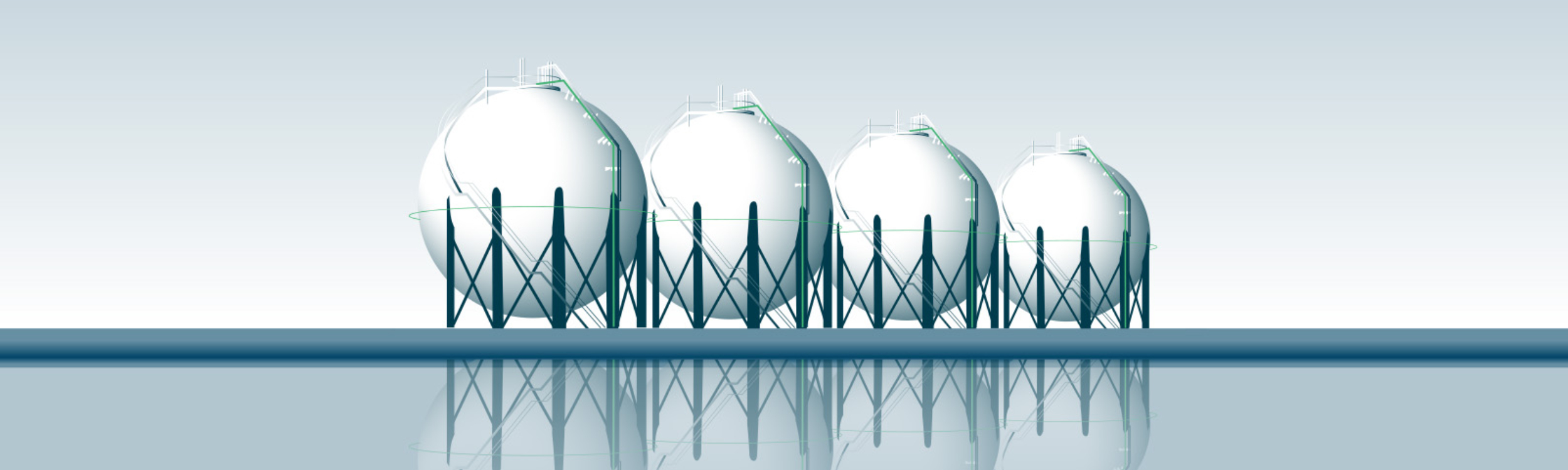
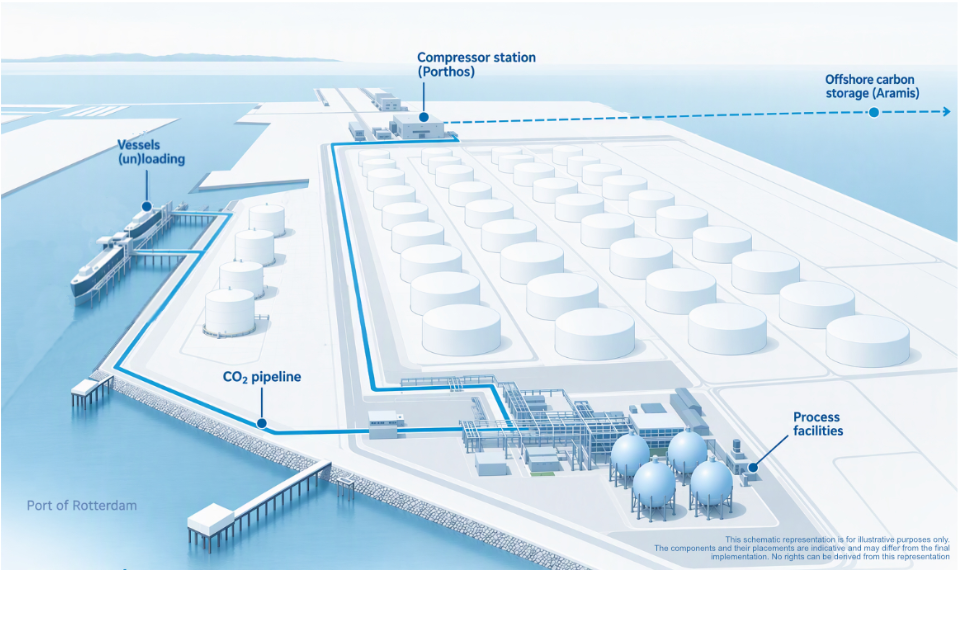
In its first phase, the terminal will consist of two jetties, each equipped with three Marine Loading Arms (MLAs) for CO2-vessels, four storage tanks, a system of low- and high-pressure pumps, and integrated safety systems. When a vessel arrives at the terminal, liquid CO₂ will be pumped ashore through the MLAs. The CO₂ will then flow through a pipeline to the storage tanks for temporary storage. From these tanks, the pressure will be increased before the CO₂ is transported via the Aramis offshore infrastructure and ultimately stored in depleted gas fields deep beneath the North Sea seabed.
Continuous CO₂ export
A key design principle is balancing variations in CO₂ supply and export. This is essential because the offshore infrastructure benefits from a stable and continuous flow of CO₂. The four storage tanks therefore serve as an important buffer between fluctuating incoming volumes and continuous export to the storage locations beneath the North Sea. Combined with the terminal’s flexible pumping system, this ensures a constant flow of CO₂ to the offshore infrastructure.
Ready for the first development phase, prepared for the future
The terminal has been designed to support the first phase of development while allowing for future expansion. Space has been reserved for an additional jetty, extra storage tanks, and potential future functionalities such as ship reloading operations or the reception of CO₂ transported by rail. The terminal will start with a capacity of 5.4 Mtpa and can be expanded to 10 Mtpa in a future phase.
“The terminal is designed to deliver what is needed today while leaving room for future growth. This allows us to work as cost-effectively as possible while creating a robust foundation for the further development of CO₂ infrastructure,” says Fulco van Geuns, Project Direct CO2next.
Safety, environment and sustainability
To minimise emissions, the project aims to maximise the use of electrically powered equipment during construction. During operations, vessels moored at the terminal will be able to connect to shore power, reducing emissions while alongside.
Achieving this milestone together
The FEED phase was carried out by engineering partner Sener Ingeniería y Sistemas S.A. (Sener), in close collaboration with CO₂next’s technical team. The combined expertise, in-depth engineering knowledge, and shared commitment to quality and safety have played a major role in achieving this result.This milestone highlights the constructive and effective collaboration between the teams of Sener and CO₂next.
“The completion of the FEED phase represents the result of extensive knowledge, dedication and teamwork,” says Leon van Soest, Project Manager CO₂next. “Thanks to the contributions of the project team and our engineering partner, we now have a technically mature design that is safe, robust and deliverable. This provides a strong foundation for the next phase of the project.”
An important step towards realization
With the completion of the FEED phase, CO₂next has reached an important milestone in the development of the terminal. In the coming period, CO₂next will continue preparations for tendering and other activities that support progress towards a Final Investment Decision (FID). These next steps further strengthen the development of the infrastructure needed to help industries reduce their CO₂ emissions through the transport and storage of CO₂. CO₂next plays an important role in this effort by providing access to CO₂ storage beneath the North Sea, including for companies that are not located near existing or future CO₂ pipeline networks.